
George Strait
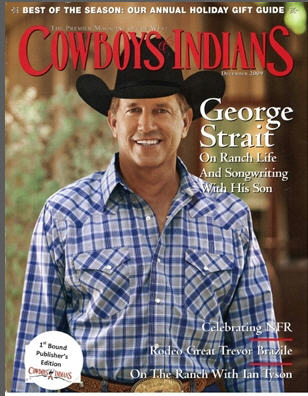
- Cowboys & Indians Cover Story
After dominating the record charts and selling out concert venues for the better part of 30 years, thereby establishing yourself as the uncontested King of Country, what can you do for an encore? If you’re George Strait, you just keep doing what you’ve always done. All you need is a little Twang.
The latest in a seemingly endless line of immaculately crafted crowd-pleasers released by the 57 year old Texas born living legend, Twang—Strait’s 26th studio album and an instant number one No. 1 smash hit—underscores what every fan already knows: The reign of King George will continue unabated as long as Strait keeps making records.
This time out, Strait is delighting fans and impressing critics with an ambitious diversity of songs and styles, ranging from the boot-scooting country classicism of the the title cut (co-written by Grammy winner Jim Lauderdale) to the loose-goose honky-tonk of “Some Kind of Crazy” (co-written, and originally recorded by, Delbert McClinton), from the outlaw balladry of “Arkansas Dave” (the first solo songwriting credit of Strait’s son, Bubba Strait to an en espanol perfecto rendition of the mariachi standard “El Rey.”
“All the songs are different,” Strait agrees. On the other hand, “I think all my albums are different enough where I don’t ever feel I did this the last time. Sure, it’s country music. I’m not trying to change that. But each song that you do is different.”
Which may be the key to explaining why the hits just keep on coming for George Strait: his song-selecting saavy. Quite simply, he knows what he likes and what other folks like as well. “And that,” says veteran music row tunesmith Dean Dillon, “is one of the things that made him the King of Country. He has the innate ability to look at a song, get inside that song—and deliver it the way it was written in a way that you can relate to.”
Dillon vividly recalls a fateful afternoon back in 1981 when he and fellow songwriter Frank Dycus were kicking back after a productive morning of collaboration. “We’d walked out on the porch,” he says, “and pulled the tabs on a couple of beers, when Blake Melvis, who was George’s first producer, pulled up to the curb and rolled down the window and said “Hey! I got this kid from Texas, and I’m looking for some songs for him.”
That new kid was George Strait, then freshly signed to MCA Records and hard at work on his first album for the label. “Like just about everyone else in Nashville at the time,” Dillon says “I’d never heard of the guy. So I asked Blake, ‘Well, who’s he sound like?’ Because back then, everyone sounded like somebody. Everyone imitated Merle Haggard or George Jones or somebody. And Blake said, “Well, he really doesn’t sound like anybody else. He’s kind of got his own thing going on.”
Impressed and intrigued by Mervis’ description, Dillon and Dycus pitched their latest composition, a tune titled “Unwound,” even before they actually met Strait. It wasn’t until a few weeks later, when he visited the studio where Strait was recording, that Dillon fully realized what a smart move he and Dycus had made and what a lucky break it was for all parties involved.
At that first meeting, Dillon recalls “My first impression was—well I thought he was a cowboy for darn sure. And I thought we we're an odd match: He was pretty quiet and I was this crazy old songwriter.”
Right from the start, Dillon thought Strait had a great voice. “But I also thought that he was going to have a rough way to go because during those days, I knew that nobody was going to pitch their top stuff to him because he was new.”
Dillon, however, heard opportunity knocking. “Yeah,” he admits. “I pitched him everything I had but the kitchen sink after I heard him record that first time.”
Dillon co-wrote six tracks (five of them with Dycus) for Strait Country, Strait’s platinum-selling debut album. Twenty-eight years and more than 50 songs later, he and Strait remain good friends and frequent collaborators. Indeed, Dillon was the tunesmith Strait summoned to join him and his son, Bubba, while father and son were working on songs for Twang. Dillon eagerly accepted the invitation but with no small amount of surprise, since his good buddy hadn’t tried his own hand at songwriting for decades.
“For a lot of years, I put songwriting on the back burner,” Strait says. “I’ve had so much luck and have been so successful finding material from other writers that I got really lazy about it. Writing, for me, is not easy. It requires a lot of time and can be pretty intense.”
On the other hand, the creative process can also be quite a bit of fun—provided that you have the right collaborators. “I really enjoyed being able to write with Dean and Bubba,” Strait says. “Dean has been a big part of my recording career and we’ve been friends for many years. And seeing my son writing on his own, and being able to write with him, was just the greatest thing.”
To hear Dillon describe it, the songwriting sessions at Strait’s South Texas ranch were no-sweat, low-pressure, highly productive experiences. For example, working on “Living for the Night”—the first No. 1 single from Twang—entailed nothing more strenuous than fleshing out a long-considered scenario. “George told me pretty much the story around the song that he’d had in his head for a while,” Dillon says, “And then he and Bubba and I just sat there for a while. I came up with a little melody, and we go to cranking on that. And a couple of hours later we had a song…a pretty darn good one, actually.”
Another longtime collaborator with Strait, singer-songwriter Jim Lauderdale worked on two tunes for Twang, including the title cut. His relationship with the King of Country dates back to 1991, when Strait selected two songs from Lauderdale’s album Planet of Love—“Where the Sidewalk Ends” and “King of Broken Hearts,”—for Pure Country, the 1992 film in which Strait portrayed a glitzy country music star who goes AWOL from a concert tour and returns to his hometown roots. Since then, Lauderdale—a two time Grammy Award winner for his bluegrass recordings—has worked profitably as a tunesmith for Patty Loveless, The Dixie Chicks, Donna the Buffalo, and repeatedly, Strait.
“I owe my career as a recording artist as well as a songwriter to George Strait,” Lauderdale says. Writing songs for him has really kept me afloat during the years. It’s allowed me the freedom to cut bluegrass records and traditional country records—and other things that are more off the wall. If it wasn’t for George Strait, I wouldn’t be able to do that.
After all these years, Lauderdale continues to be impressed by Strait’s talents as a singer, musician, and showman. “It’s not just because he’s successful,” Lauderdale says. “In this business, there are people who are successful, and sometimes super-successful, but they don’t have longevity. But George—I think he’s still really evolving. He’s not just making the same record year after year. And I think this new record shows continued growth and evolution as a recording artist.”
Dillon readily agrees. “I know this for a fact: George is singing better now than he’s ever sung in his life,” the songwriter marvels. “And he transcends generations. I go to his concerts and there’s 40,000 people out there anywhere from 8 years old to 80. He is a constant deliverer of great music.”
The big difference now, Dillon believes, is the variety of that great music. “It seems to me that in the past 10 years, George has just knocked the fences down. I mean who would have thought that George Strait would have recorded a Spanish-language song? And who would have though that George Strait would have recorded a Delbert McClinton song like ‘Same Kind of Crazy’ like he does on Twang? But he did. And here’s the thing. He made them his own. He took them, studied them, recorded them, and made them his own.”
With characteristic modesty, Strait downplays the notion that he blazing trails or expanding horizons. As he sees it, he’s still doing what he’s always done, even when what he does takes other people by surprise. “Same Kind of Crazy,” for example, is included on Twang simply because “I just love the feel of that song,” he says. In fact, “we recorded it in one take in the studio. That hardly ever happens.”
So what does Strait think is the secret to his success? “If I knew the answer to that,” he replies, “I could have a whole new career selling it. I’ve just tried to do what I do the best I can do it—from picking songs to making records to playing shows”
And while he says he can foresee a day when he rides off into the sunset to spend his golden years on a South Texas ranch, Strait isn’t quite ready to give up his crown. “It’s a little too late to be talking about long term goals for me,” he says. “Every year I get to do it now is another year I didn’t think I would have.”
And he’s determined to make every minute count. “I still feel as excited about it as I always have. I had a great tour this year and enjoyed every minute of it—and I’m looking forward to my upcoming tour next winter.”
Strait says he’s also looking forward to making many more records in the future. “It’s great to be able to do something you love for a living. And believe me, I’m loving it.”
10/8/2009
This page was updated June 10, 2010
 | ||||||

| ||||||


HOLIDAY GIFT GUIDE --- DECEMBER 2009
| ||||||

RETURN TO:


